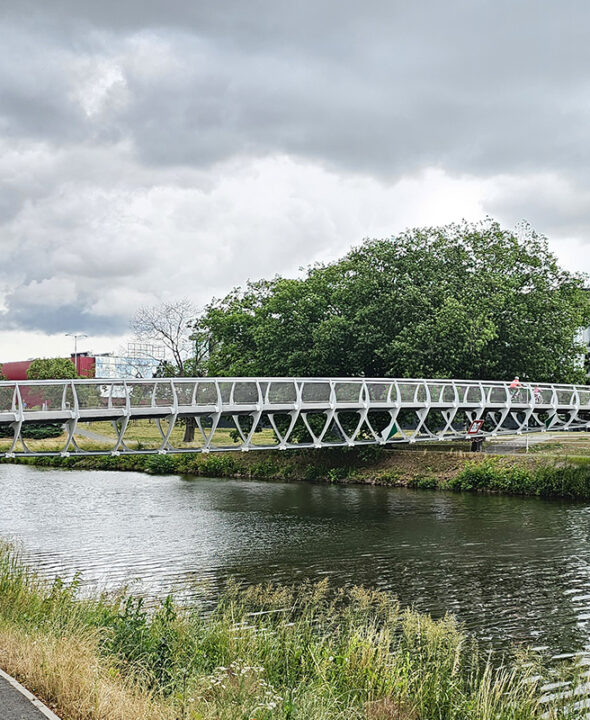



In 2023, a footbridge for pedestrians and cyclists in the center of Hradec Králové was completed and officially opened. The bridge spans the Elbe River near the Aldis Conference Center between Škroupova and Collinova Streets. It was designed by Valbek spol. s r.o. based on an architectural design by architects Libor Kábrt, Gabriela Elichová, and Martin Elich. The bridge was constructed by SMP CZ, a.s.
The footbridge consists of a single arch 103 m long and 6 m wide. The structure is composed of freely suspended load-bearing steel cables, a steel truss structure, and 39 prefabricated bridge deck segments made of high-strength concrete. The prefabricated segments were supplied by KŠ Prefa. For their production, the company used Valucem C120 ultra-high-performance concrete (UHPC). This concrete is reinforced with steel fibers, making it several times stronger than the concrete typically used in bridge construction. The combination of a striking architectural design and the use of this exceptional material has resulted in a slender, airy structure.
Advantages of Using UHPC
-
The high mechanical properties of UHPC have made it possible to produce slender precast components that are lighter than those made of conventional concrete
-
The use of UHPC Valucem C120 with dispersed steel reinforcement increases the structure's resistance to failure and enhances its resistance to environmental influences
-
The use of dispersed steel reinforcement partially replaces conventional rebar and speeds up the production of prefabricated components
-
The steel suspension cables, which are freely suspended beneath the segmental bridge deck, contribute to the bridge's striking architectural appearance
Client:
Architectural Design: Libora Kábrt, Gabriela Elichová, Martina Elich
Implementation: KŠ Prefa, SMP CZ, a.s., Valbek spol. s r.o.


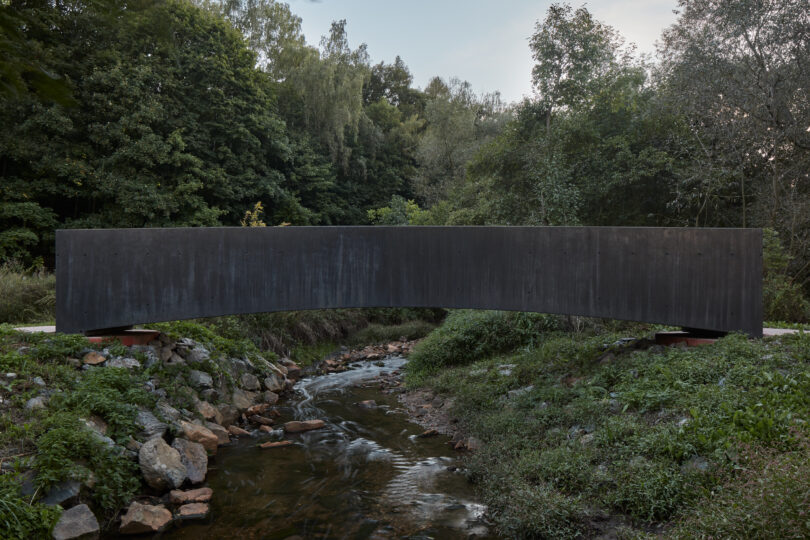
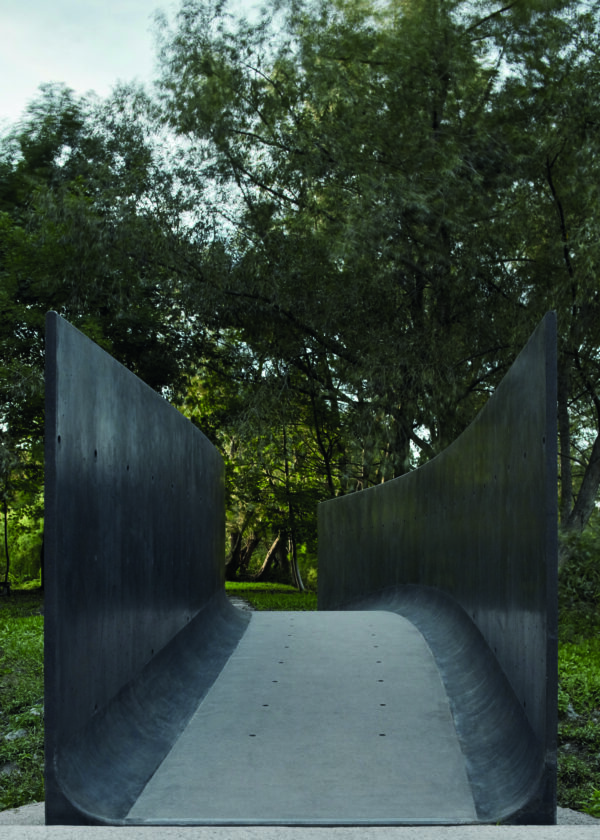
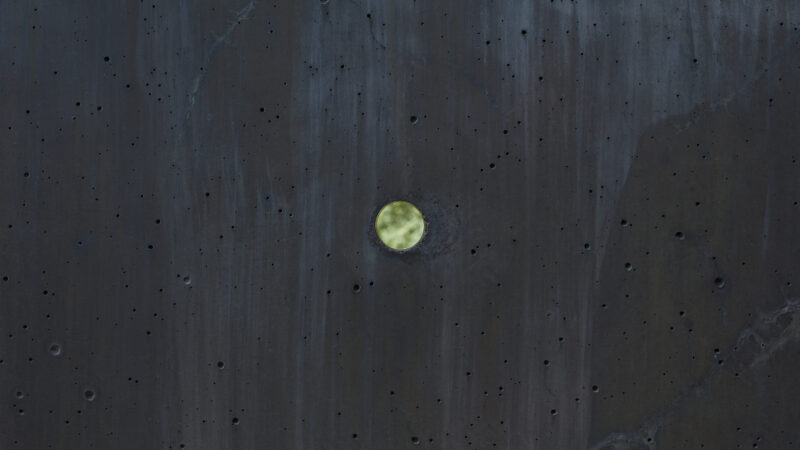
In 2018, an experimental footbridge made of UHPC was constructed. The bridge spans the Dřetovický Stream in the Central Bohemian village of Vrapice, near the city of Kladno. It connects the village with the right bank of the stream, where the cemetery is located. Architects Ondřej Císler and Petr Tej conceived the footbridge as a “magical portal between the world of the living and the dead.” The structure is made of a cast of high-strength, frost-resistant UHPC Valucem C120 concrete with steel microfibers providing omnidirectional reinforcement. The resulting structure appears very cohesive and delicate. The footbridge weighs 3.5 metric tons, and the total amount of material used is 1.4 cubic meters of UHPC Valucem C120. The footbridge has a span of 10 meters and a width of 1.5 meters.
Opposite the footbridge is a statue called ‘Strážce’ by the sculptor Jan Hendrych. It is based on original Baroque models and complements the overall spatial composition of the bridge.
It is the first UHPC structure without conventional reinforcement to be in public use. The design of the footbridge was one of the six finalists in the 2019 Czech Architecture Award competition.
Advantages of Using UHPC
- The thin-walled shell structure made it possible to significantly reduce the weight of the entire footbridge
- The use of UHPC with dispersed steel reinforcement, which completely replaced conventional rebar, once again led to a significant reduction in the structure's weight and a decrease in the labor required for production
- The use of colored Valucem C120 UHPC contributed to the striking architectural appearance and the durability of the color, which could not have been achieved with a surface coating
Client: The City of Kladno
Implementation: KŠ Prefa, Kloknerův ústav
Architectural Design: Ondřej Císler, Petr Tej


The main supporting structure of the footbridge connecting Holešovice and Karlín consists of a continuous girder made of white UHPC Valucem C120. Thanks to the use of the white version of UHPC Valucem C120, the bridge has excellent mechanical properties, high durability, and a unique architectural appearance resembling white marble. The continuous girder, which connects the Holešovice and Karlín banks, is 300 m long and seamlessly transitions into an 80-meter-long side ramp leading to Štvanice Island, thus forming a single, unified structure without expansion joints.
The girder of the main bridge and the ramp is made of segments with longitudinal prestressing and an H-shaped cross-section. It consists of two web-plate side parapet girders with an intermediate bridge deck slab supported by transverse ribs. The through width in the main direction defined by the parapet is 4.0 m and the external dimensions of the segment are: height = 1.85 m and width = 5 m. At the point of the ramp, the through width defined by the railing is 3,0 m and the external dimensions of the segment are height = 1,85 m and width = 4 m. The thickness of the parapet forming the railing is 220 mm. The thickness of the bridge deck oscillates between 85 and 125 mm.
The outermost span on the Holešovice bank is designed as a lifting span due to the necessity to comply with the condition of placing the structure above the water level Q2002+1.0m in case of flood. In the event of a flood, the hydraulic system can lift the end of the footbridge by 3.2 m.
Advantages of Using UHPC
- The high mechanical properties of UHPC made it possible to create a slender structure that is lighter than one made of conventional concrete
- The use of UHPC with dispersed steel reinforcement increases resistance to failure and enhances resistance to environmental effects
- The use of white and partially colored Valucem C120 UHPC resulted in a striking architectural appearance
Client: Magistrát hl. m. Prahy
Implementation: Skanska a.s., KŠ Prefa
Architectural Design: Petr Tej, Marek Blank, Jan Mourek, Aleš Hvízdal, Jan Hendrych


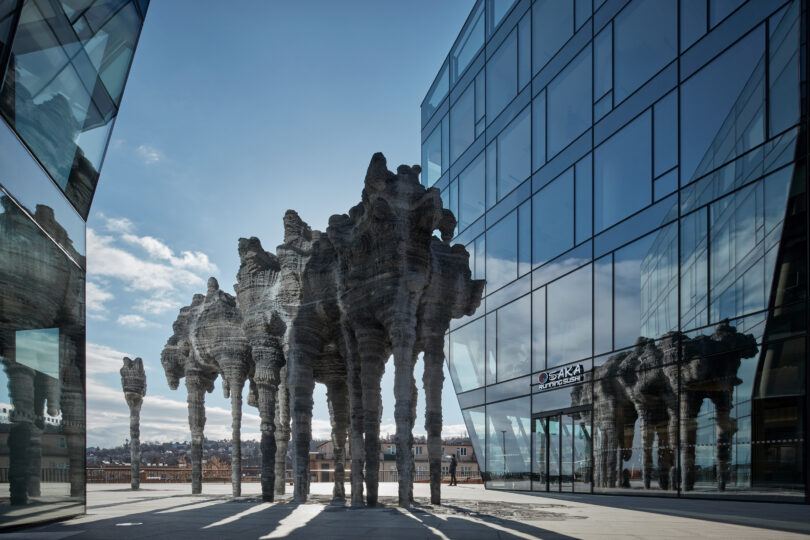
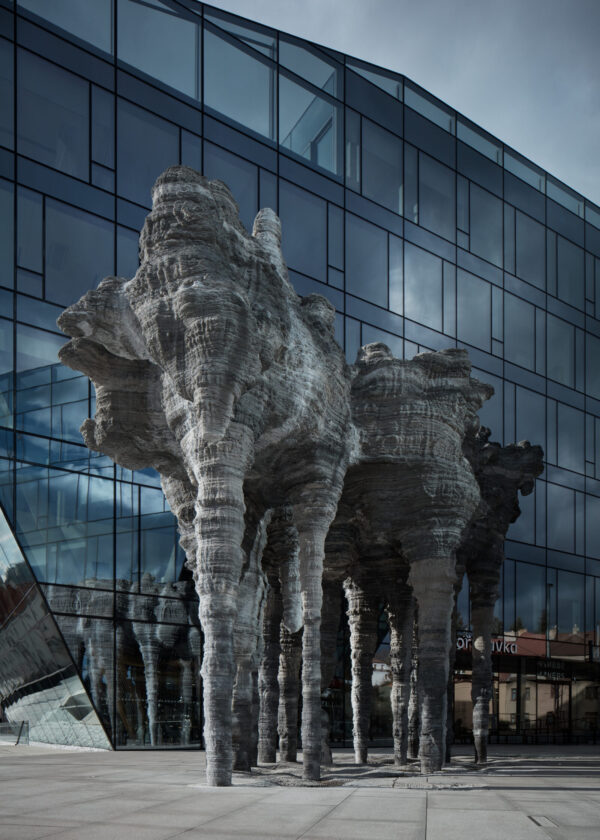
The sculpture ‘Na Horu’ by the Czech-Argentinian artist Federico Díaz refers, like the architecture of the buildings of Bořislavka, to the historical trade route that led through the place. In the past, roads and paths were built in gorges or mountain passes formed by glaciers or rain. It is no coincidence that the word "trail" has the same etymological origin as "to flow."
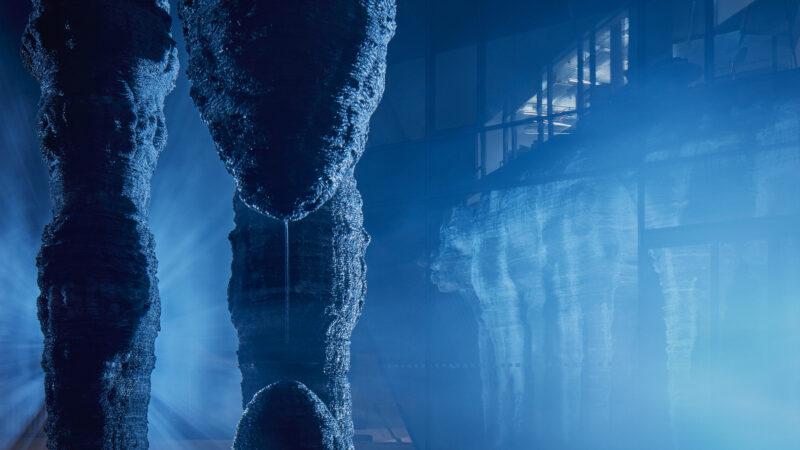
The "Na Horu" shapes refer to the shale and rock that has been sedimenting beneath the Bořislavka River for millions of years and which continue to shape the town's appearance today. But at the same time, upon closer examination, the sculpture shows a regular and wrinkled structure created by a machine. The work thus evokes the tension between nature and humanity. It is a reminder of the permanence that transcends us, as well as the human ability to adapt themselves and their environment.
The sculpture ‘Na Horu’ weighs 57 000 kilograms and is 7.5 metres high. The team of Studio Federico Díaz developed the So Concrete robotic fabrication technology specifically for its realization, and chose the high-strength concrete UHPC (Ultra High-Performance Concrete), provided by PREMIX servis ltd., which made it possible to create a subtle yet monumental work.
Client: KKCG company
Implementation: Frederico Díaz Studio


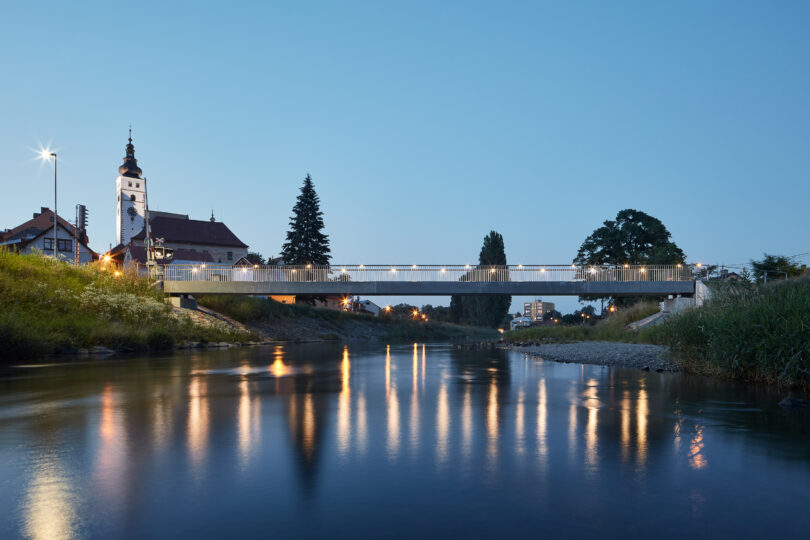
A bridge like a stone laid across the water. The footbridge over the Lubina River in Příbor is a unique segmental structure—the first of its kind in the Czech Republic. The footbridge is designed as a simple beam with a span of 35 meters, formed by joining five double-chamber segments, each 7.2 meters long, 2.5 meters wide, and 0.8 meters high. From a structural engineering perspective, the supporting structure has a unique slenderness ratio of 1:44 (height to length). UHPC Valucem C120 with dispersed steel microfiber reinforcement was used as the structural material.
The volume of the footbridge is lightened by twenty large polystyrene blocks. It is thus a hidden lattice structure consisting of a system of interacting longitudinal and transverse ribs. The segments of the footbridge are longitudinally connected by prestressing ropes routed in the longitudinal ribs of the inner grating. The prestressing is, unusually for segmental structures, provided by raised cables of parabolic course. A unique multiple protection system for the prestressing cables was designed on the footbridge. The footbridge is supported on abutments by pairs of 200 mm diameter steel cylindrical roller bearings.
The lower structure of the bridge is designed with standard reinforced concrete abutments with perpendicular wings. The structure is based on micropiles. The railing of the bridge consists of stainless-steel posts with solid oak handrail with integrated lighting.
Advantages of Using UHPC
- The high mechanical properties of the UHPC used to manufacture the precast components made it possible to create a structure that is slender and lighter than conventional concrete, thereby enabling the construction of an unusually slender prestressed bridge structure
- The use of UHPC with dispersed steel reinforcement increases resistance to failure and enhances resistance to environmental effects
- The use of dispersed steel reinforcement, which partially replaces conventional rebar, has accelerated the production of prefabricated components
Client: město Příbor
Implementation: STRABAG a.s. (2018), KŠ Prefa
Architectural Design: Petr Tej, Marek Blank a Jan Mourek